
Table of Contents
ToggleYour analytics might look healthy. But if the wrong people are showing up, nothing will convert. Here’s what to do about it.
Here’s a situation a lot of website owners know all too well: your traffic numbers look decent, maybe even good, but nothing is actually happening. No sales. No leads. No calls. Just visitors who show up and disappear without a trace.
Nine times out of ten, that’s not a traffic volume problem. It’s a traffic quality problem.
The difference between targeted traffic and random traffic is one of the most important concepts in digital marketing — and also one of the most misunderstood. People get caught up chasing big visitor counts when the real question is: who are those visitors, and do they actually care about what you offer?
In this guide we’ll break down exactly what separates targeted traffic from random traffic, why quality visitors produce better results, and what you can do to make sure more of the right people are landing on your site.
Targeted traffic isn’t just “people on the internet who found your site.” It’s a specific kind of visitor — someone whose situation, interests, and needs line up meaningfully with what you’re offering.
Think about it from a real-world angle. If you run a bakery and someone walks in because they saw your sign for fresh sourdough, that’s targeted. They wanted bread, they found you. Now imagine a tour bus drops 50 strangers at your door who were just told to meet there — most of them aren’t even hungry. That’s random traffic. The numbers look bigger, but the results are worse.
In digital terms, targeted traffic usually checks two or three of these boxes:
For a deeper look at how this works in practice, our guide on what targeted traffic means and why it matters is a great starting point.
Targeted visitors can come from anywhere — organic search, paid campaigns, email, social media, or a well-configured targeted traffic service. The source matters less than the alignment. When who they are matches what you do, good things tend to happen.
Random traffic arrives at your site without a meaningful connection to your audience or offer. These visitors might have clicked out of curiosity, stumbled across a misleading ad, or been swept in by a bulk traffic package with no real targeting behind it.
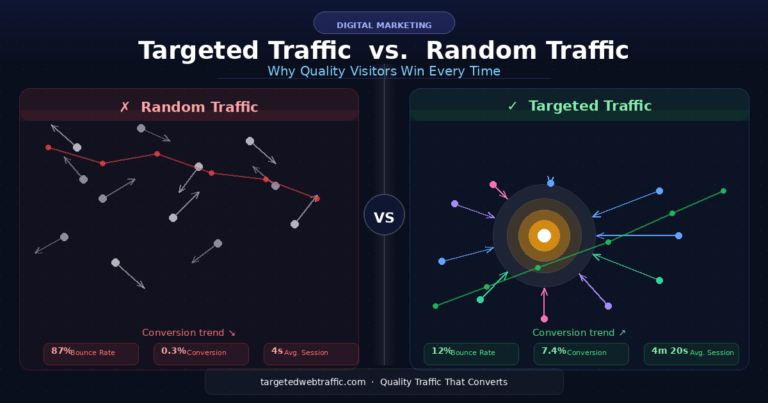
The behavior of random visitors is remarkably consistent. They land, glance around for a second (if that), and leave. Your bounce rate climbs, your session time tanks, and your conversion rate scrapes the floor. You end up with an analytics dashboard that looks active but tells you almost nothing useful about real customer behavior.
Here’s the core of the argument — the specific ways targeted traffic consistently outperforms random traffic.
The average website conversion rate across all traffic types sits around 3.7% in 2024 — and that number gets dragged down significantly when a large chunk of your traffic was never a realistic prospect in the first place. For PPC landing pages specifically, WordStream data puts the average closer to 2.35%, with the top 10% of pages converting at 11.45% or higher. Either way, the gap between a well-targeted page and a poorly-matched one is enormous. Targeted visitors convert better because they arrive already partway through the decision process — you’re helping someone who was nearly there, not cold-pitching a complete stranger.
Targeted visitors scroll further, click into other pages, and actually read your content. All of that engagement signals to search engines that your content is genuinely useful, which supports your organic rankings over time. Random traffic pollutes your engagement data and makes it much harder to see what’s actually working. You start optimizing pages that aren’t actually broken — because the real problem is who’s landing on them.
When visitors genuinely represent your potential customers, every data point becomes meaningful. Which pages hold attention? Where do people drop out of your funnel? These questions are only answerable when the behavior you’re measuring reflects real audience intent — not a flood of unrelated visitors masking the signal.
When someone arrives on your site and it immediately feels like they found exactly the right place, that’s where trust starts. The message matches what they searched for. The product fits what they need. That first impression is what drives return visits, referrals, and positive reviews. Targeted traffic doesn’t just help you convert once — it brings in the kind of visitors who might actually come back and tell others. Random visitors who feel misled just close the tab.
Every dollar you spend on traffic is an investment. Targeted traffic almost always delivers better ROI because more of those visitors take meaningful action. Even when targeted traffic costs more per visitor than a bulk campaign, the cost per lead and cost per conversion tends to be significantly lower. We’ve covered this in detail in our breakdown of how targeted traffic unlocks real ROI for your website.
An e-commerce store buys 20,000 broad “global” visitors with no targeting filters. Visitors come from dozens of countries where shipping isn’t available, with no particular interest in running. Result: a fraction of a percent converts and the cost per sale is brutal. Now flip it — 3,000 visitors from countries they ship to, filtered by fitness and running interest, landing on pages matched to their intent. Fewer visitors. Far more sales. The difference isn’t the product or the website. It’s who’s showing up.
A plumbing company serving a single city gets visitors from all over the world through generic directories and cheap bulk traffic. Most will never call a local plumber. Compare that to using local SEO services and geo-targeted traffic to reach people actively searching for “emergency plumber” in that city. Every visit is a real potential customer. Same number of visitors — entirely different results. Working with a local SEO company that understands your specific market and service area makes this kind of targeting far more precise and effective.
If you only serve certain countries, regions, or cities, geography is everything. Sending traffic from the wrong location is wasted effort regardless of how interested those visitors might be. Geo-targeted traffic lets you specify exactly where your visitors come from — down to country, region, or city level.
Interest targeting filters visitors based on what they’ve shown an interest in through browsing behavior. Someone in the market for digital marketing tools is more likely to care about your SaaS product. Matching interest categories to your niche is one of the most reliable ways to improve traffic quality fast.
There’s a big difference between someone searching “what is SEO” and someone searching “hire an SEO agency.” The first is curious; the second is shopping. Our organic keyword-targeted traffic service is built around matching real visitors to the specific search terms most relevant to your pages — helping you get in front of people who are already looking for what you do.
If your site is built for mobile users, desktop-heavy traffic will underperform. If your app is iOS-only, sending Android users creates unnecessary friction. Device targeting ensures the visitor experience matches the product experience from the moment they land.
Before you can attract the right traffic, you need a clear picture of who “right” means. Where do they live? What problem are they solving? What words do they use when they search? The clearer your picture, the more precisely you can configure everything that follows.
A visitor searching “how to rank higher on Google” should land on an educational guide, not a pricing page. Someone searching “hire an SEO agency” needs credentials, case studies, and a contact form. Mismatched pages bleed conversions even when traffic is well targeted.
Look at behavior by source in GA4’s Traffic Acquisition report. Which channels bring visitors who stay and convert? Which bounce in under ten seconds? Double down on what’s working. Pause or fix what isn’t. GA4 also measures “engagement rate” rather than bounce rate — an engaged session means the visitor spent at least 10 seconds on site, viewed more than one page, or completed a conversion. It’s a more useful signal than the old metric.
Organic SEO and content build compounding long-term results. Paid search and paid social let you test and scale quickly. A well-configured targeted traffic campaign fills in volume while those other channels gain momentum.
The average bounce rate across all industries in 2025 sits around 45%, but it varies significantly depending on your sector, device split, and traffic sources. What matters more than hitting an industry benchmark is the trend: if bounce rate is rising while conversions drop, that’s a traffic quality signal worth investigating immediately.
More traffic is a seductive idea because the number is easy to see and easy to report. But if that traffic isn’t the right traffic, you end up with inflated metrics and invisible problems. You think your funnel is broken. You waste time optimizing pages that aren’t the real issue.
The better question is never “How do I get more traffic?” — it’s “How do I get more of the right traffic to the right pages at the right time?” That shift in thinking is what separates sites that steadily grow from sites that spin their wheels.
Working with a quality traffic provider can make a real difference — as long as what you’re getting is real human visitors with actual targeting options, delivered through legitimate sources that won’t put your domain at risk.
At Targeted Web Traffic, we’ve spent more than two decades building the networks and relationships that make genuinely targeted traffic possible. Whether you need geo-targeted visitors, interest-filtered traffic matched to your niche, or keyword-driven organic traffic that reflects real search behavior — all of it is trackable in Google Analytics so you can see exactly what’s happening.
The difference between targeted and random traffic isn’t a small nuance you can worry about later. It’s the difference between a site that quietly bleeds marketing budget and one that steadily builds leads, sales, and momentum.
Define who your visitors should be. Build content and pages that meet them where they are. Choose traffic sources that give you real control over who shows up. Measure behavior and conversions — not just visits.
Do those things consistently and you’ll find that fewer, high-value visitors can outperform massive volumes of traffic that were never going to convert in the first place. Quality really does win, every time.
Explore our geo-targeted, interest-filtered, and keyword-matched traffic services — all trackable in Google Analytics.



2 Responses
I like the efforts you have put in this, regards for all the great content.
wow i really like this article, very well detailed and a lot of time is invested in this. keep up the good work and i will be checking back for new update.