

Table of Contents
Toggle
More than 60% of all web traffic today comes from mobile devices — yet most businesses are still building strategies that put desktop first. If you’re not optimizing for both, you’re almost certainly leaving money on the table. In this guide, we break down the real difference between mobile traffic and desktop traffic, which one converts better for your industry, and exactly how to target both for maximum growth in 2026.
Whether you’re a small local business, an e-commerce store, or a service provider trying to grow online, understanding how your visitors arrive — and how they behave differently depending on their device — is one of the most powerful insights you can have. It’s the kind of data that changes your entire marketing strategy.
Let’s get into it.
Mobile traffic refers to visitors who land on your website through a smartphone or tablet. These users are typically on the go, browsing quickly, often multitasking — and their expectations are completely different from someone sitting at a desktop computer with a coffee in hand and a full keyboard in front of them.
For businesses, mobile traffic is no longer a secondary consideration. It’s the primary reality. Google officially switched to mobile-first indexing back in 2019, which means Google now uses the mobile version of your website to determine your search rankings — not the desktop version. If your site loads slowly on a phone, looks broken on a small screen, or is hard to navigate with a thumb, Google notices. And so do your visitors — they leave within seconds.
But here’s what makes mobile traffic fascinating from a marketing perspective: it’s not just about volume. It’s about intent. Mobile users search differently. They use shorter, more conversational queries. They’re often looking for something right now — a phone number, a location, a quick answer, or a fast purchase. This “micro-moment” behavior, a term Google coined to describe these rapid decision points, is where businesses either win or lose customers.
👉 Related: Buy Targeted Mobile Traffic — Android & iOS Visitors — Reach on-the-go prospects with mobile-specific traffic campaigns targeted by device, location & category.
Desktop traffic refers to visitors who access your website from a traditional computer or laptop. While desktop’s share of total web traffic has declined significantly over the past decade, it remains the dominant device for specific types of behavior — and for certain industries, it still drives the majority of conversions.
Desktop users tend to spend more time on a website per session. They browse more pages, read longer content, and are more likely to complete complex forms or multi-step checkout processes. If you’re selling high-ticket services, B2B software, financial products, or anything that requires careful research and consideration before purchase, desktop traffic is still your most valuable audience.
Think about it from a user’s perspective: if you’re comparing insurance plans, researching enterprise software, or filling out a mortgage application, you’re probably not doing that on your phone during your commute. You’re sitting at your desk, taking your time, evaluating your options carefully. That’s the desktop mindset — and it’s a powerful one for conversions.
Mobile wins the attention game. Desktop wins the conversion game. Smart marketers don’t choose one — they build a strategy that captures both at the right moment in the customer journey.
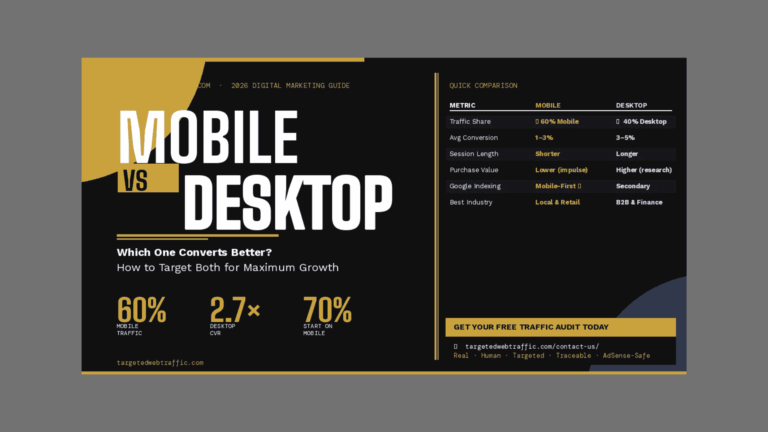
Before we talk strategy, let’s look at the core differences between mobile and desktop traffic across the metrics that matter most to your business:
| Factor | 📱 Mobile Traffic | 🖥️ Desktop Traffic |
|---|---|---|
| Traffic Volume | Higher — 60%+ of all web traffic globally | Lower — approx. 35–40% of global traffic |
| Average Session Duration | Shorter — users browse quickly, make fast decisions | Longer — deeper browsing, more page views |
| Bounce Rate | Higher — especially if site isn’t mobile-optimized | Lower — users are more patient and engaged |
| Conversion Rate (avg) | 1–3% average across industries | 3–5% average — up to 2.7× higher than mobile |
| Purchase Value | Lower average order value (quick, impulse buys) | Higher average order value (considered purchases) |
| Search Behavior | Voice search, short queries, “near me” searches | Long-form queries, research-heavy, comparison searches |
| Google Indexing Priority | Mobile-First — Google indexes mobile version first | Secondary — rankings based on mobile performance |
| Best For | Local businesses, restaurants, quick services, apps | B2B, SaaS, financial services, high-ticket products |
Here’s the truth that most marketing articles won’t tell you: there is no single winner. The answer depends entirely on your industry, your offer, and where your customer is in their buying journey.
On average, desktop traffic converts at a higher rate — studies consistently show desktop conversion rates running 2 to 3 times higher than mobile. But that doesn’t mean mobile traffic is less valuable. Not by a long shot.
Here’s the nuance that changes everything: while mobile users may not convert immediately, they frequently initiate the purchase journey. Research from Google shows that 70% of purchase decisions begin on a mobile device — even when the final purchase is completed on desktop. This is what marketers call cross-device behavior, and it completely changes how you should think about mobile traffic.
If someone discovers your business on their phone during their lunch break, visits your website, browses your products — and then pulls up their laptop that evening to complete the purchase — your analytics will show a desktop conversion. But the mobile visit was just as critical in driving that sale. This is why businesses that ignore mobile traffic are almost always underestimating its true value.
Set up cross-device tracking in Google Analytics 4 to see the full customer journey across mobile and desktop. You’ll likely discover that mobile is influencing far more conversions than your last-click attribution is showing you.
For certain business types, mobile traffic doesn’t just match desktop performance — it outperforms it significantly. If your business falls into any of these categories, mobile should be your top targeting priority:
On the flip side, these industries still see desktop traffic as their primary conversion driver — and rightly so. If you’re in one of these spaces, don’t neglect mobile awareness, but make sure your desktop experience is exceptional:
Even if desktop drives your conversions, a poor mobile experience can destroy your Google rankings and keep your desktop audience from ever finding you. Mobile optimization is non-negotiable for SEO in 2026 — regardless of where your conversions happen.
Getting mobile traffic to your website is one thing. Getting it to convert is another. Here’s what actually moves the needle for mobile visitors:
Mobile users are impatient. Google’s research shows that 53% of mobile users abandon a site that takes longer than 3 seconds to load. If your website isn’t loading in under 2 seconds on a 4G connection, you’re losing more than half your mobile visitors before they even see your content. Use Google’s PageSpeed Insights tool to identify and fix your mobile speed issues — it’s free and incredibly revealing.
Mobile UX is about thumbs, not mouse pointers. Buttons need to be large enough to tap comfortably. Navigation menus need to be simplified. Forms should require as few fields as possible. And your most important call-to-action — your phone number, your “Buy Now” button, your contact form — needs to be visible without scrolling. This is called above-the-fold optimization, and it’s critical for mobile conversion rates.
Mobile search is heavily local. Phrases like “near me,” “open now,” and “best [service] in [city]” are dominated by mobile users. Make sure your Google Business Profile is fully optimized, your NAP (Name, Address, Phone) information is consistent across the web, and your content naturally includes local keywords. Voice search optimization — using conversational, question-based content — is also growing rapidly as smart speaker and voice assistant usage climbs.
👉 Related: 5 Local SEO Strategies to Increase Traffic & Rankings — Learn how to dominate local search results and drive more targeted visitors from your city and region.
Building organic mobile traffic takes time. If you want faster results — particularly when launching a new product, testing a landing page, or expanding into a new market — buying targeted mobile traffic is one of the most efficient ways to get real, engaged mobile visitors to your site immediately. Targeted mobile traffic campaigns let you specify the device type (Android or iOS), geographic location, and interest category — so you’re not just getting volume, you’re getting the right audience on the right device.
While mobile gets all the headlines, smart businesses still invest heavily in their desktop traffic strategy — because that’s often where their highest-value customers convert. Here’s how to maximize it:
Desktop users are readers. They have a keyboard, a large screen, and (usually) more time. Long-form blog posts, detailed guides, case studies, comparison pages, and in-depth product descriptions all perform significantly better on desktop. If your content is shallow and thin, desktop users will bounce just as fast as mobile users. Give them something worth reading — content that genuinely answers their questions and establishes your expertise.
Most desktop visitors don’t convert on their first visit. In fact, studies show it takes an average of 7 touchpoints before a prospect makes a purchase decision. Retargeting campaigns — showing your ads to people who have already visited your website — are exceptionally effective for desktop users who are in the research and consideration phase. A well-timed retargeting ad that reminds a desktop visitor of the product or service they were browsing can dramatically improve your overall conversion rate.
For desktop-dominant industries, buying targeted organic traffic paired with a strong SEO strategy gives you the best of both worlds — immediate visibility through paid traffic while building long-term authority through organic rankings. This dual approach is especially powerful for B2B companies and professional services where every converted visitor is worth hundreds or thousands of dollars in lifetime value.
The most successful businesses in 2026 aren’t choosing between mobile and desktop. They’re building strategies that honor the unique behavior of each device type at each stage of the customer journey.
Think of it like this: mobile captures attention and starts the conversation. Desktop closes the deal. Your job is to make both experiences exceptional — and to make sure that when someone transitions from one device to the other, your brand stays visible, recognizable, and compelling throughout.
This means having a mobile-optimized website that loads instantly and makes it easy to engage. It means having a desktop experience rich enough to justify a purchasing decision. It means running traffic campaigns that reach both audiences with device-specific messaging. And it means tracking your full customer journey across devices so you can see exactly where your traffic and conversions are coming from.
According to Think with Google, brands that create seamless cross-device experiences consistently outperform competitors who optimize for only one device type. The data is clear: reach people on mobile, convert them on desktop, and make sure the path between those two moments is as smooth as possible.
👉 Related: Buy Standard GEO-Targeted Traffic That Converts — Drive real, targeted visitors to your website from any country, region or interest category — fast, safe and traceable.
Neither is inherently better — but mobile is more critical for SEO rankings. Since Google switched to mobile-first indexing in 2019, it crawls and ranks your website based on the mobile version first. This means if your mobile site is slow, broken, or hard to navigate, your rankings will suffer across all devices — including desktop. From a pure SEO standpoint, your mobile experience must be flawless, regardless of where most of your conversions come from.
Desktop users typically have more time, a larger screen, a full keyboard, and are in a more deliberate browsing mindset. This makes it easier to complete multi-step checkout processes, fill out long forms, compare options side by side, and make high-consideration purchases. Mobile users, by contrast, are often on the go and browsing in short bursts — which leads to higher bounce rates and lower immediate conversion rates. However, many mobile sessions that don’t convert directly still influence a later desktop conversion, so the full value of mobile traffic is often underreported.
Google Analytics 4 (GA4) gives you a full breakdown of your traffic by device category — mobile, desktop, and tablet. Go to Reports → User → Tech → Platform / Device Category to see exactly how your audience is split. You can also view conversion rates, bounce rates, session duration, and revenue by device type, which helps you identify where your biggest opportunities and biggest drop-off points are.
It depends on your industry and goals. If you run a local business, restaurant, retail store, or any service where customers search on the go, buying targeted mobile traffic delivers fast, relevant visitors who are actively looking for what you offer. If you’re in B2B, financial services, or high-ticket sales, investing in standard GEO-targeted desktop traffic is likely to produce stronger conversion results. The smartest approach for most businesses is to run both simultaneously and let the data guide your budget allocation over time.
Yes — and the best traffic providers allow you to specify exactly which device type you want to target. At Targeted Web Traffic, you can run mobile-specific campaigns targeting Android or iOS users, as well as standard desktop campaigns segmented by geography, interest category, and more. All traffic is real, human, and fully traceable in Google Analytics — so you can measure performance by device and optimize your campaigns accordingly. There are no bots, no proxies, and no fake clicks.
Targeted Web Traffic delivers real, human visitors to your website — segmented by device, location, and interest category. Start your campaign today and see results within 24 hours.
Have questions? Contact our team — we’re happy to help you find the right traffic strategy for your business.



One Response
You’re so awesome! I don’t believe I have read a single thing like that before. So great to find someone with some original thoughts on this topic. Really.. thank you for starting this up. This website is something that is needed on the internet, someone with a little originality!